What to ask on a demo: five questions before you buy event technology
Five questions to ask on a demo before you buy or switch event technology, and who on your buying committee should ask each one.
- Author
- By Bri Francom
- Reviewed by
- John Bowers
- Published
- Reading time
- 5 min read
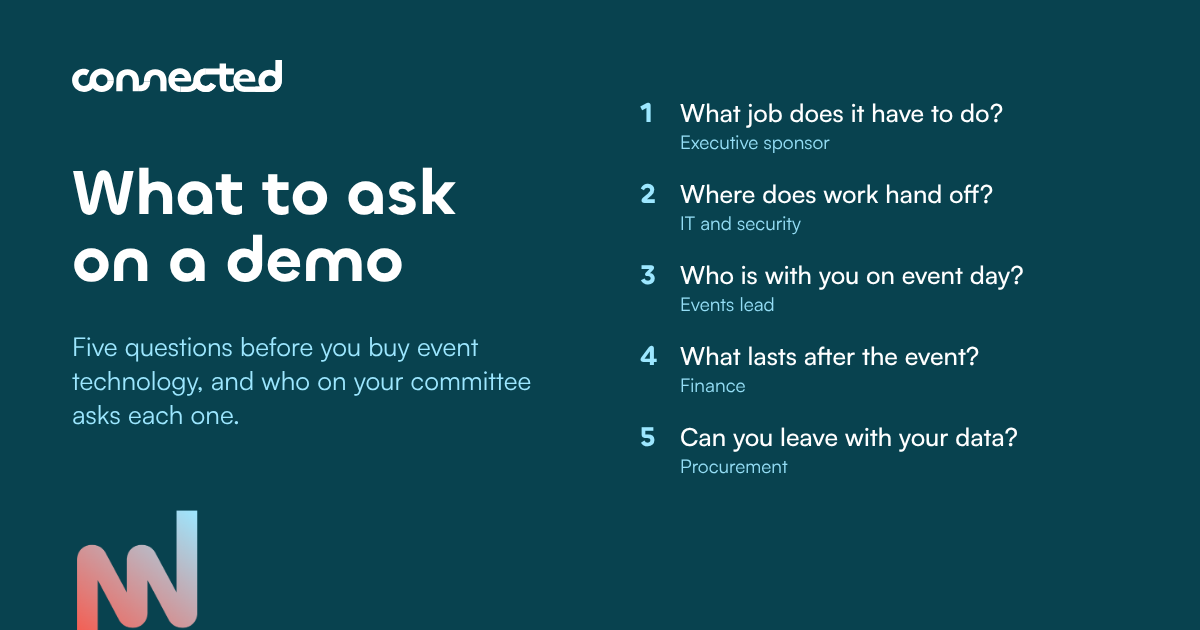
A demo is built to show you the best day. Your program will have harder ones. So before you buy or switch event technology, go into every demo with five questions: what job the tool has to do, where work hands off between systems, who is with you on event day, what keeps your community going after the event ends, and how you leave with your data. Those answers tell you more than a long feature list.
This is what to ask on a demo when the decision isn't yours alone. A team that runs a convention of thousands, or dozens of events a year, rarely buys alone. An events lead, IT and security, finance, procurement and an executive sponsor each sign off on part of it. Each question below names who on the committee should ask it, so nobody finds the gap after the contract is signed.
What to ask on a demo, question by question
1. What job does this tool have to do?
Who asks it: the executive sponsor.
Write the job in one sentence before the first demo. Not "we need an app." Something like: "We need registration, the event itself, and a place for our people to stay in touch between conventions." Then name the one result you'll check after your next event.
The sponsor owns this question because they'll be asked about it later. If the committee can't agree on the sentence, a demo won't settle it. Event Tech Live makes the same point: define the job and how you'll measure it before you buy.
2. Where does work hand off, and who still exports by hand?
Who asks it: IT and security.
Most problems show up between systems, not inside one. Trace a real week: registration feeds your emails, check-in feeds the app, the event feeds the follow-up your team sends after. Ask which of your own tools the vendor connects to by name. Ask which connections are built and supported today, and which would need a developer.
Then ask about logins. One login for your people and your staff is a smaller security question than five. Every spreadsheet someone exports by hand is a place where a record goes missing or a date slips.
3. Who is with you on event day?
Who asks it: the events lead.
Picture the night before doors open on a multi-city tour or a convention of thousands. Something breaks. Who answers, how fast, and do they know your program?
Ask for the name of the person you'll reach during your event hours, not a queue address. Ask how fast they respond when check-in is down versus when a session title is wrong. Ask them to show you what happens if the venue Wi-Fi fails, not describe it. A smooth demo on a quiet Tuesday tells you little about a live morning with a line at the door.
4. What keeps your community going after the event ends?
Who asks it: finance.
Finance wants to know whether the money buys one week a year or a whole year. Many event tools do a strong convention week and then go quiet. A month later, the conversations people started on site have scattered across email threads and group chats.
Ask what your people can still do on the platform in March: keep talking, find the next gathering, pick up the relationships they started in the hallway. Ask to see a real month between events, not the event week again. If the answer is "export your list and use something else," you're buying for the event, not for the year.
5. Can you leave with your data?
Who asks it: procurement.
Ask who owns your attendee and event data. Ask whether you can export all of it, in a standard format, whenever you want. Ask what happens to it when the contract ends, and how renewal and notice work. Settle the way out while you still have leverage, before you sign.
This isn't pessimism. A vendor who answers it plainly is telling you how they expect to keep your business.
How we think about this at Connected
We built Connected around question 3. Service-first Software puts authentic human attention first and builds the software to support it. A person who knows your program leads; the platform serves them.
That changes how we'd want you to evaluate us, or anyone. Ask whether a real person answers the same day. Ask whether they know your program by name. Ask whether the engineers sit beside the people who answer. Ask whether that service comes with the platform or costs extra. You should get a straight answer to each, including where a vendor isn't the right fit.
Events end. Relationships don't. Pick the tool that's still useful when the next event is months away.
Questions people ask
What should I ask on an event software demo?
Ask five things: what job the tool has to do, where work hands off between your systems, who supports you on event day, what your community can do between events, and how you get your data out if you leave.
Who should be in the room for an event technology demo?
Everyone who signs off: the events lead, IT and security, finance, procurement and the executive sponsor. Give each one a question to own.
How do I compare event platforms fairly?
Use the same questions and a real week from your own program in every demo. Ask each vendor to show you, in the product, rather than tell you.